
Dormant company tax return: when and how to file
How to file a dormant company CT600 (UK, 2026)
Prerequisites at a glance
- Difficulty
- Beginner
- Tools you'll use
-
- HMRC dormancy notification service
- Government Gateway login enrolled for Corporation Tax (if filing)
- Commercial CT600 filing software (if filing)
- Have ready
-
- Company UTR
- Company registration number (CRN)
- HMRC notices and period dates
- Accounts and company records
- Date trading stopped (if previously trading)
In short: A dormant company must still file a Company Tax Return if HMRC has issued a notice to deliver one. A dormant nil CT600 is appropriate only if the company was genuinely dormant for the period being reported. After you tell HMRC the company is dormant, you normally do not file another return unless HMRC asks or the company becomes active again. Companies House accounts are a separate obligation. HMRC's dormant-company guidance explains the filing requirement.
Start with the notice and the period, not the tax bill: owing £0 does not, by itself, make a company dormant. This guide covers ordinary UK limited companies. It does not cover the special dormancy treatment for clubs, associations or flat-management companies.
What does 'dormant' mean for Corporation Tax?
A company is usually dormant for Corporation Tax if it has not started trading, or has stopped trading and has no other income. Having no customers, making a loss or owing no tax is not the same as being dormant.
For example, bank interest can make a non-trading company active for Corporation Tax. Conversely, preliminary work such as writing a business plan does not necessarily mean a new company has started trading. HMRC distinguishes preparatory activity from carrying on a business in its trading and non-trading guidance.
Does a dormant company have to file a tax return?
Yes, if HMRC has sent a notice to deliver a Company Tax Return. The notice creates a filing obligation even if no Corporation Tax is payable. Check the dates it covers before choosing a dormant return. HMRC's return-obligations guidance explains what must be delivered.
| Your situation | What to do |
|---|---|
| HMRC has been told the company is dormant; there is no outstanding notice and no new activity | Normally no further CT600 is needed. Keep checking HMRC correspondence and maintain the separate Companies House filings. |
| HMRC has issued a notice covering a wholly dormant period | File the required return, using nil tax figures supported by the records. Do not ignore the notice because the tax is £0. |
| The company is dormant now but traded during the period requested | Report the actual trading period and figures. Do not replace them with a whole-period dormant return. |
| There were no sales, but there was bank interest or continuing business activity | Check the non-dormant filing route. No sales or no tax does not establish dormancy. |
| Dormant accounts have already been filed at Companies House | Check HMRC separately. Those accounts do not answer an HMRC notice. |
If the notice appears to cover the wrong dates, contact HMRC promptly and keep its response. Do not assume that telling HMRC about dormancy cancels an existing filing requirement. For the no-sales distinction, see no income but not dormant.
What is the difference between dormant for HMRC and dormant for Companies House?
Dormant for HMRC concerns the company's tax activity. Dormant for Companies House means no significant accounting transactions in the financial year. A company can meet one test but not the other, so check each separately.
| Dormant for HMRC (Corporation Tax) | Dormant for Companies House | |
|---|---|---|
| Main question | Was the company active for Corporation Tax? | Were there significant accounting transactions? |
| Filing consequence | A notice still requires a Company Tax Return | Annual accounts and a confirmation statement still apply |
| Which accounts? | Follow the return's accounts requirements | Use dormant accounts only if the company qualifies; HMRC dormancy alone is insufficient |
Companies House excludes its filing fees, late-accounts penalties and payment for shares on incorporation from significant transactions. Ordinary bank charges are not one of those exceptions. A company with no taxable income may therefore still need non-dormant accounts. The Companies House dormancy rules set out the test and exceptions.
How do you tell HMRC your company is dormant?
Use the official Tell HMRC your company is dormant service. Have the company name, 10-digit company UTR and, if it previously traded, the date trading stopped. Notification and filing an outstanding return are separate tasks.
Step 1: Check you're actually dormant
Check the whole period requested, using bank statements, invoices and company records. Look for interest and other income as well as sales. If trading stopped part-way through the year, retain that date and the earlier trading figures; being dormant today does not erase them.
Step 2: Tell HMRC the company is dormant
Complete the HMRC dormancy notification service and keep the confirmation. The service also explains how to notify by phone or post if you cannot use it online. Future returns are not normally required while the company remains dormant, unless HMRC asks for one.
Step 3: File any return HMRC has already requested
If HMRC has requested a return, prepare it for the correct period with the required accounts and computations. Use the dormant nil-return route only where the facts support it. Your company UTR, CRN and Corporation Tax-enrolled Government Gateway details are needed to file yourself. HMRC's own joint filing service closed on 31 March 2026, so online filing now uses commercial software, directly or through an agent. GOV.UK explains the closure and filing routes.
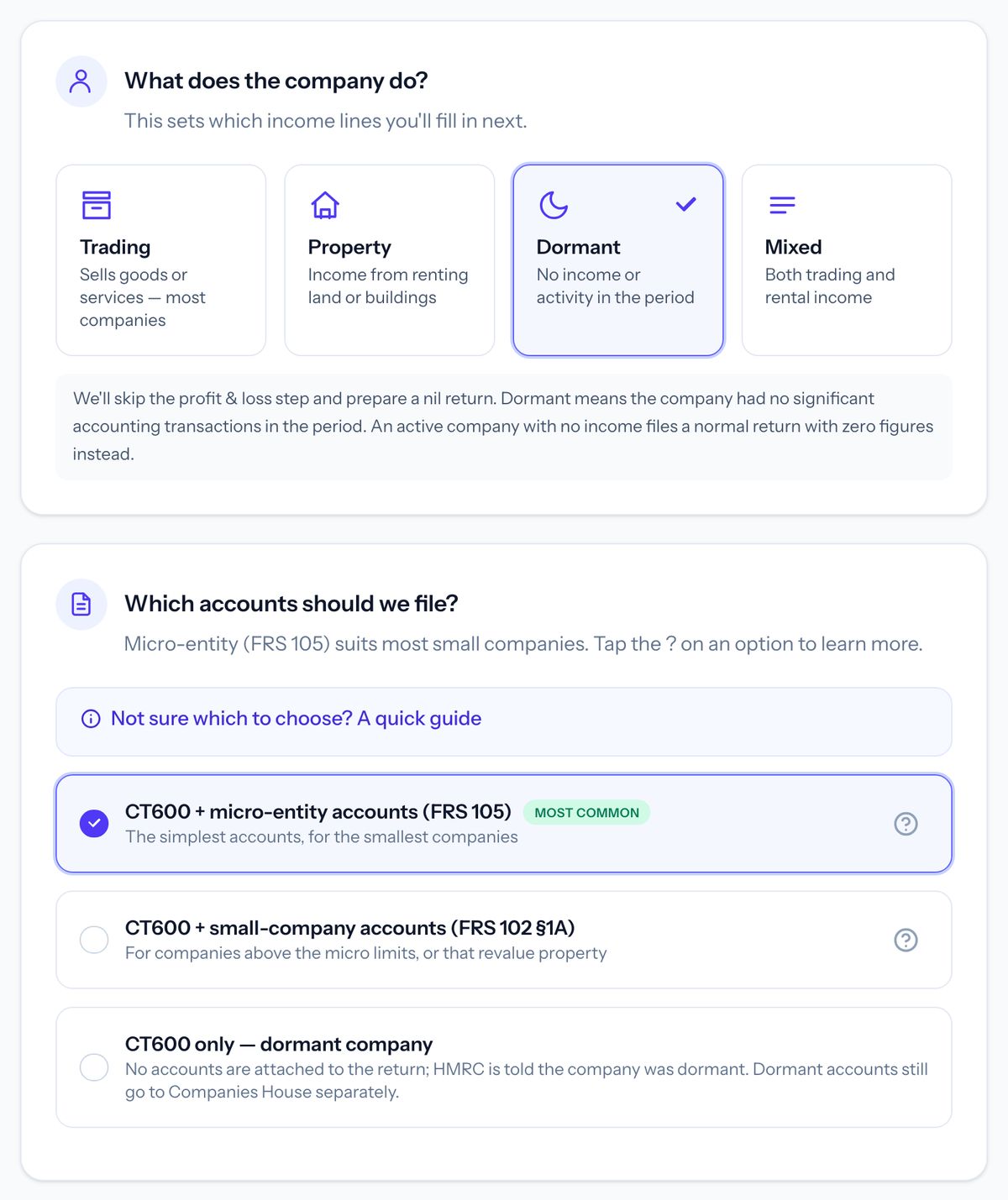 In Taxley: choosing Dormant under "What does the company do?" when you start the return skips the profit and loss step and prepares a nil return (demo company).
Step 4: Keep evidence
Keep the notice, dormancy notification, relevant bank statements, accounting records and copies of anything filed. Record when trading stopped, or that the company never traded. This gives you evidence for the period rather than relying on the current label in an account or on the public register.
Step 5: Check the filing receipt and remaining obligations
Where a return was required, confirm successful submission and retain HMRC's acknowledgement and reference. A draft or rejected submission is not a filed return. Receipt does not mean HMRC has agreed the figures or the dormancy treatment; HMRC can still check the return. Check Companies House accounts and the confirmation statement separately. HMRC explains what its acknowledgement means.
What goes in a dormant company tax return?
A dormant Company Tax Return reports the relevant company details and period, with nil taxable profit and nil Corporation Tax where appropriate. A return normally includes the CT600, accounts and tax computations; follow the notice's requirements. Nil tax does not mean every balance-sheet figure is zero. HMRC describes the return's contents.
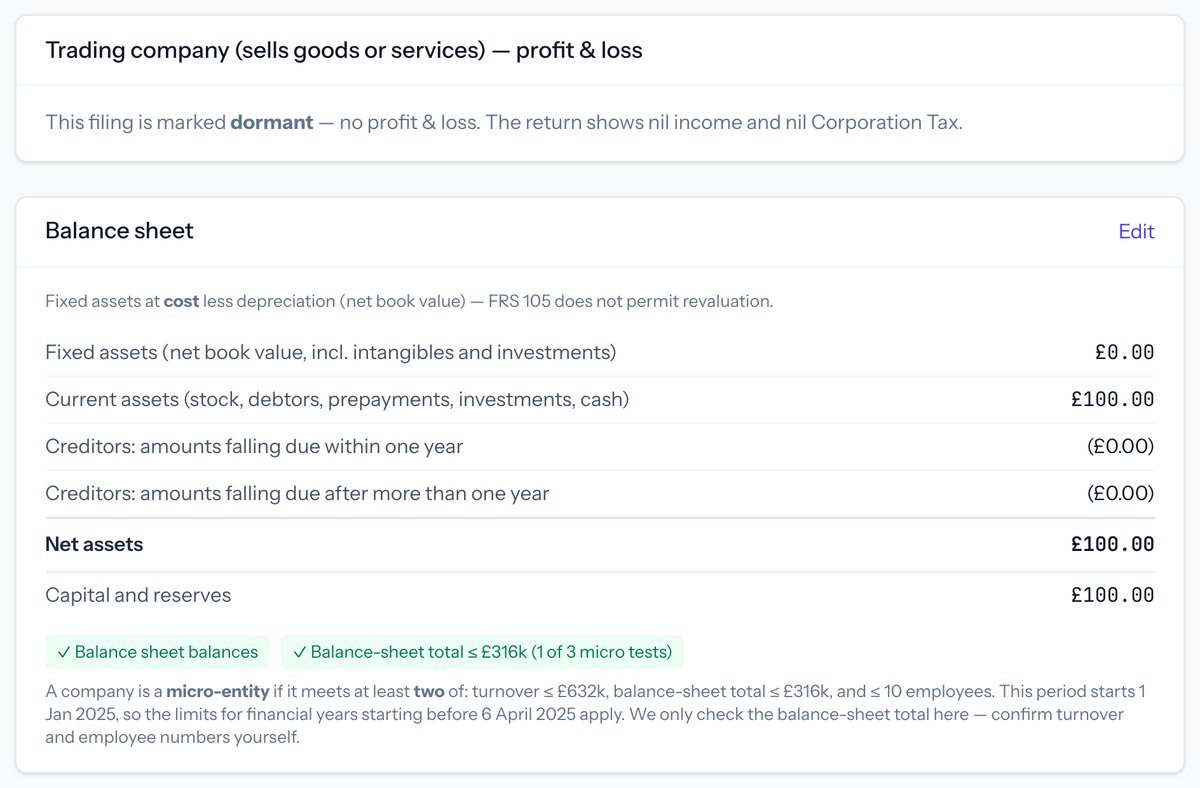 In Taxley: the review of a dormant return shows no profit and loss, just the balance sheet and a check that it balances (demo company).
Illustrative example: the demo balance sheet above has £100 of assets and £100 of capital and reserves, while its current-period taxable profit and tax are £0. Use your own records, not the demo amounts. Dormancy is not an instruction to delete existing assets, liabilities or share capital.
Before filing, check the UTR and CRN belong to the right company, the dates match the return required, and the accounts are appropriate. Our CT600 guide explains the return, and company UTR guide shows where to find the tax reference.
What is the dormant company tax return deadline?
The usual Company Tax Return deadline is 12 months after the period ends. For example, a period ending 31 March 2026 normally has a filing deadline of 31 March 2027. A late-issued notice or an unusual period of account can produce a different statutory deadline, so check the notice and HMRC's filing-date rules. Do not use the Companies House accounts deadline as the CT600 deadline.
Nil tax does not remove late-filing penalties. For returns with a filing date on or after 1 April 2026, the normal fixed penalties start at £200 once late, with a further £200 after three months. Repeated late filing can increase these amounts. Earlier filing dates use the previous rates. See HMRC's current penalty table and the dated rate-change notes.
How much does it cost to file a dormant company's return?
Separate tax, software charges and Companies House fees. There is no Corporation Tax payable on a genuine nil-tax return, but filing software may charge. Taxley's dormant return costs £9.50; check the current pricing and dormant filing-cost comparison before choosing a service. If HMRC does not require a return, do not buy a CT600 filing just because the company remains registered.
Companies House does not charge for filing dormant accounts, although a software or service provider may. A qualifying company that has never traded can currently use its online dormant-accounts service. Companies House says accounts filing will move to software only from 1 April 2028. See its dormant-accounts explanation and current filing guidance.
The confirmation statement is a different filing. Its Companies House fee is £50 online, payable with the first statement in each 12-month payment period, as checked on 8 October 2026. Companies House publishes the fee schedule. For the accounts routes, see filing company accounts with Companies House online.
Which software can file a nil CT600 for a dormant company online?
A dormant company's nil CT600 can be filed online through commercial software. Taxley is one option: for £9.50 it prepares and files the nil CT600 to HMRC and, if the return includes eligible dormant accounts, files them at Companies House once the return is paid and finished.
The screenshots show Taxley's dormant workflow using a demo company. Selecting Dormant skips the profit-and-loss entry step; you still check the period, company details and balance sheet. This route is for a genuinely dormant period, not a trading company with a £0 tax bill.
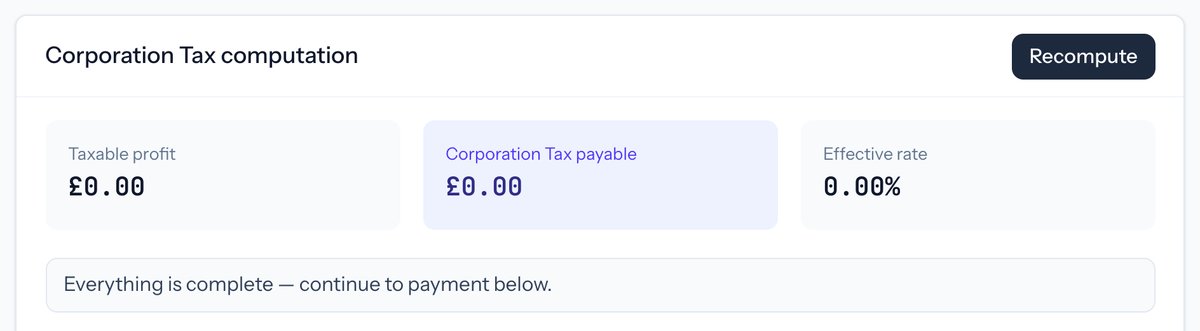 In Taxley: for a dormant company the computation shows nil taxable profit and nil Corporation Tax (demo company).
Companies House filing of eligible accounts is included at no extra cost when the Taxley return includes them; you use the company's Companies House authentication code to submit them. The confirmation statement remains separate. If you need a nil CT600 and the dormant route fits your records, see what Taxley's dormant return includes and start. If the facts are different, check which Taxley filing route fits your company before starting.
Online filing is the normal route. GOV.UK also provides limited paper-filing exceptions, including a reasonable excuse or filing in Welsh, in its Company Tax Return overview.
Frequently asked questions
Do I have to file a tax return for a dormant company?
An HMRC notice to deliver a Company Tax Return still requires a return. Use a nil dormant return only for a genuinely dormant period. Once HMRC has been told the company is dormant, no further return is normally needed unless HMRC asks or the company becomes active again.
Is dormant for HMRC the same as dormant for Companies House?
No. HMRC looks at tax activity; Companies House looks at significant accounting transactions. HMRC dormancy does not automatically qualify a company for dormant accounts. Companies House accounts and the confirmation statement remain separate obligations.
Does a dormant company pay Corporation Tax?
A company with no taxable profits for a genuinely dormant period has no Corporation Tax for that period. That does not cancel tax from an earlier active period, a late-filing penalty or an outstanding requirement to file a return.
What happens if I ignore a notice to deliver for a dormant company?
You can face a late-filing penalty even with no tax due. For filing dates on or after 1 April 2026, the usual starting penalties are £200 once late and another £200 after three months; repeated defaults can cost more. Check the period and file the correct return rather than assuming dormancy removes the notice.
Can a new company that hasn't started trading be dormant?
Yes. A new company that has not started business activity or received income can be dormant for Corporation Tax. Preparatory work does not necessarily start a trade. Check Companies House dormancy separately, particularly if the company has incurred accounting transactions.
Can a dormant company have a bank account or receive interest?
Having an account is not the same as trading. Check what happened in it: bank interest can make the company active for Corporation Tax, and ordinary bank charges can affect Companies House dormancy. An unchanged balance and transactions during the year are different things.
Guidance checked against the linked HMRC and Companies House sources on 8 October 2026. This is general information, not advice on an individual company's tax position. Taxley prepares the filing from the details you enter; the company remains responsible for its dormancy assessment and the accuracy of its return.
Video transcript
Read the full transcript of “How to file a dormant company CT600 (UK, 2026)” (6:43)
Example company and figures are fictional. General information, not tax advice.
0:00 Intro
A letter from HMRC asks for a Company Tax Return, but your company did nothing all year. Here's how to file a nil CT600 for a dormant company. HMRC's free filing service closed on 31 March 2026, so you'll need software to do it.
0:21 Do you need to file?
If HMRC has already accepted that your company is dormant, you usually don't need to file. But if you've received a notice to deliver a Company Tax Return, you must file one, even with nothing to pay. Our example, Brimbleworth Holdings, stopped trading in 2024. Nobody told HMRC, and a notice arrived. You'll need the company's UTR, its registration number, your Government Gateway sign-in, and the company's Companies House authentication code.
0:55 How do you start the return?
Sign in to Taxley with your email and password. From your dashboard, choose "Start a new return".
Type the company registration number and look it up. Taxley fills in the company's details from the Companies House register.
It also lists the company's accounting periods. An accounting period is the stretch of time a return covers, usually the company's financial year, and for Corporation Tax it can't be longer than twelve months. The one we're filing is ready: 1 April 2025 to 31 March 2026. The older periods show as filed. The return is due twelve months after the period ends, so by 31 March 2027.
Choose "Dormant". Taxley skips the profit and loss and prepares a nil return, with micro-entity accounts for HMRC and Companies House. Continue.
Now the company's UTR, its Unique Taxpayer Reference. It's ten digits, and you'll find it on the notice to deliver a Company Tax Return, form CT603, and on other letters from HMRC. It's a different number from the company registration number, so check it carefully against the letter.
2:12 What goes on the balance sheet?
Next, the balance sheet. It's a snapshot of what the company owns and how it's funded on the last day of the period, here 31 March 2026. Even a dormant company has one. This isn't the company's first year, so answer "No". The accounts then show last year's figures next to this year's, so you'll fill in both columns. Copy last year's from the accounts you filed before.
When Brimbleworth was set up, it issued one hundred pounds of shares, but the shareholders never paid for them. So they still owe the company that money, and that's an asset. Enter £100 as called-up share capital not paid. Further down is the other side: how the company is funded. Called-up share capital is the value of the shares the company has issued, £100. Last year was exactly the same, so enter £100 in both last-year boxes too.
Net assets is what the company owns minus what it owes: one hundred pounds. It matches the share capital, so the balance sheet balances. If your shareholders did pay for their shares and the money is still in the company's bank account, enter it as cash at bank instead of share capital not paid, as long as that account doesn't earn interest. Interest is income, and then the company isn't dormant for Corporation Tax. Leave lines you don't need blank. For most dormant companies, that's everything. If yours still has something left from when it traded, such as a loan from a director, enter that too.
Average number of employees during the year: a dormant company usually has none, so choose zero. Finally, the declaration. This is your legal statement to HMRC that the return is correct and complete. Enter your name, your role, and the date the board approved the accounts. That date comes after the period ends and is printed on the accounts. For Brimbleworth, it's 15 September 2026. Then review your return.
4:19 How do you check and file it?
Taxley now shows everything before you pay. Here's the balance sheet you entered: £100 of share capital not paid, and net assets of £100. And the tax computation. It starts from the company's profit for the year and works out the tax. Brimbleworth had no income and no costs, so its taxable profit is nil, and the Corporation Tax payable is £0. That's what a nil return means: there's nothing to pay HMRC.
Taxley also prepares the accounts and tax computation that go with the return. Open the accounts to check them. They show this year and last year side by side, say the company was dormant throughout the period, and carry the directors' statements that the company is exempt from an audit. The version filed at Companies House goes on the public register.
Back on the return, tick to confirm the declaration, then pay the filing fee by card. It also covers filing the accounts at Companies House.
Now file with HMRC. Use the Government Gateway user ID for the company's HMRC account, not your email address. In our experience at Taxley, a wrong sign-in is the most common reason a return is rejected. Then your password, and file.
Once HMRC has processed it, the return shows as accepted and filed. Keep the copies Taxley saves for you.
5:47 What about Companies House?
The accounts are due at Companies House nine months after the year end, so by 31 December 2026. Companies House fines start at £150 if they're late. Add the company's authentication code, then file them from here. Companies House then checks them and accepts them.
6:09 What do you do after filing?
Finally, tell HMRC the company is dormant, so it can stop sending notices to file. If a notice does arrive, you still have to answer it. Keep filing the confirmation statement every year. And for returns due from April 2026, a late Company Tax Return costs £200 straight away, even with no tax to pay. There's a link to Taxley in the description. Thanks for watching.
Update history
- Checked filing decisions, dormancy tests, nil figures and deadlines against GOV.UK
- Answers which software files a dormant company's nil CT600
- Named what Taxley charges in the summary
Spotted something out of date? See how we handle corrections.
People also ask
Related guides

Company with no income but not dormant: do you file a CT600?
11 min read →

My dormant company has started trading: what now?
12 min read →

Cheapest way to file a dormant company's return (2026)
13 min read →

CT603 notice to deliver a Company Tax Return: what to do
15 min read →

CT41G letter from HMRC: what it is and what to do next
14 min read →

How to file a CT600 yourself: step-by-step guide
16 min read →
Ready to file your Company Tax Return?
Confirm support for your accounting period, accounts and any supplementary pages before paying. Taxley support can answer software questions, not provide a tax opinion.
Questions about your period or accounts? Ask about software support